LivesToTell
UX Design Internship · 2025-2026
My work centered on designing a storytelling platform that turns voice recordings and scattered recollections into organized, shareable legacies a family can build together, keep, and pass down.
Beyond preservation, its structured recall and guided prompting show early promise in supporting memory engagement for seniors living with Alzheimer's and dementia.
01 — Context
Seniors carry the richest stories. Existing tools were never built with them in mind.
Digital storytelling tools have multiplied, but they optimize for engagement and assume digital fluency. Seniors are the least likely to be comfortable using them. Less than one in five seniors report feeling at ease with AI and gamification theory is drastically different for older adults.
We set out to build an accessible platform around the way seniors actually communicate: through voice, natural dictation, and relationships.

My grandmother has never owned a smartphone. She does not know what the cloud is. My inspiration for this project came from her. She has a voice I am not ready to lose and the person I kept designing for.
- Rural India - Spoken Dialect: Bhojpuri - No digital fluency - No device - 8000 miles away02 — Research
Testing with the people who would actually use it.
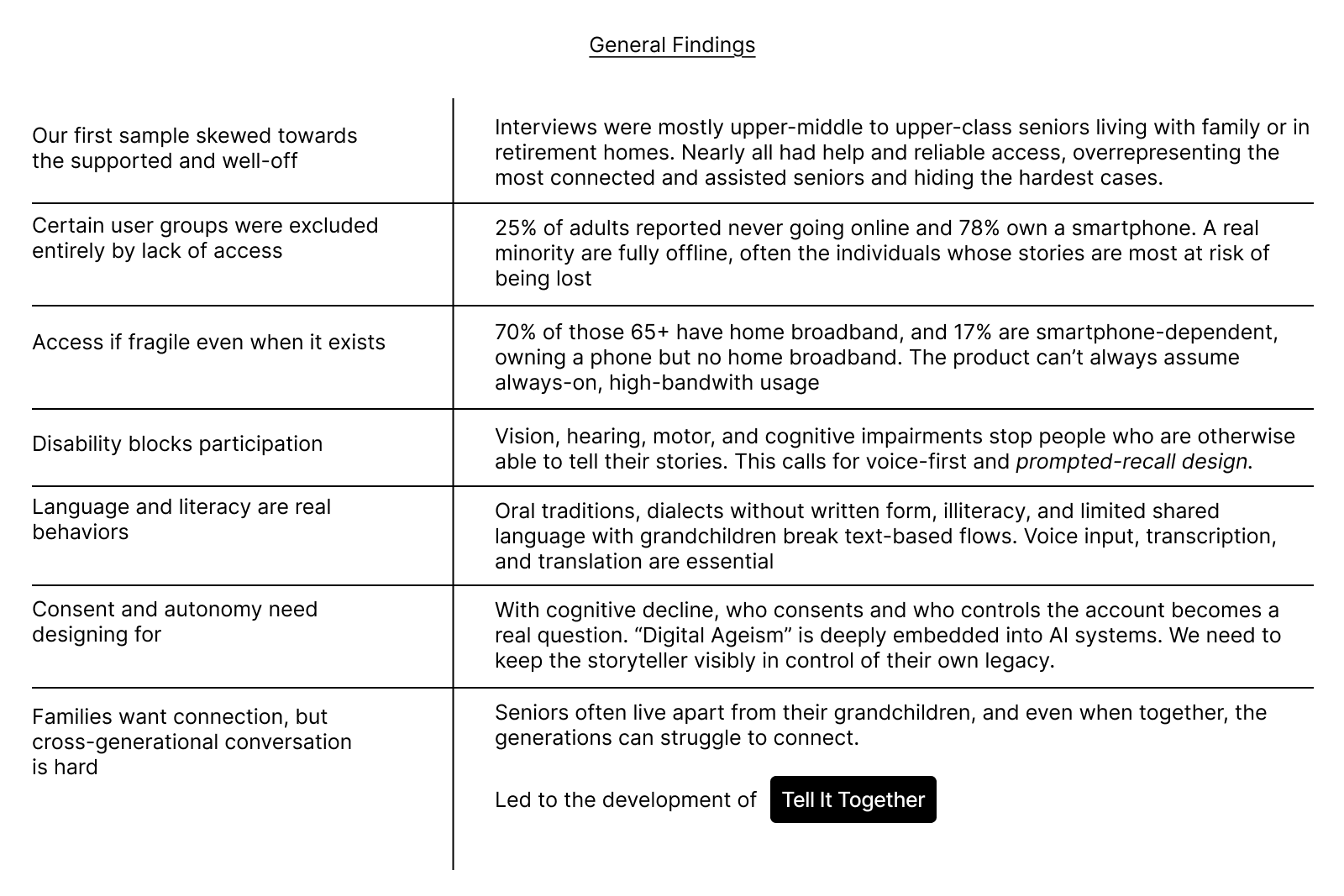
The engineering team was planning to ship a bare-minimum MVP first and improve UX later. Accessibility wasn't a stated priority. I wanted to test whether that was safe, so I ran user testing with seniors across very different contexts.
I recorded interactions, tracked time-on-task and navigation errors, and brought the results back to the team. As the sole designer on the project, I made the case for prioritizing accessibility early and kept it front and center as we built. Keeping that focus took intention on an all-engineering team, where the non-linear & exploratory nature of design is easy to overlook in favor of a linear path to shipping.

Gamification for seniors is connection
Problem
Families want to stay connected, but conversation across generations is hard. Seniors often live far from their grandchildren, and even when they are in the same room the distance still shows. Both sides are unsure what to ask or what to share, and the moment can feel awkward instead of close. What families were missing wasn't only a way to save stories. It was a reason to sit down together.
Solution
Tell it Together is a feature I pitched to my co-founders that made its way into the product. It turns storytelling into a shared activity: a grandchild, child, friend, or caregiver joins from their own phone, linked to the storyteller's account, and the two build a story side by side or as assistance.
The storyteller remains the author of their own life and the act of making a story together becomes the connection sought between generations.
04 — Recording & Copilot
Built around the way seniors actually communicate.
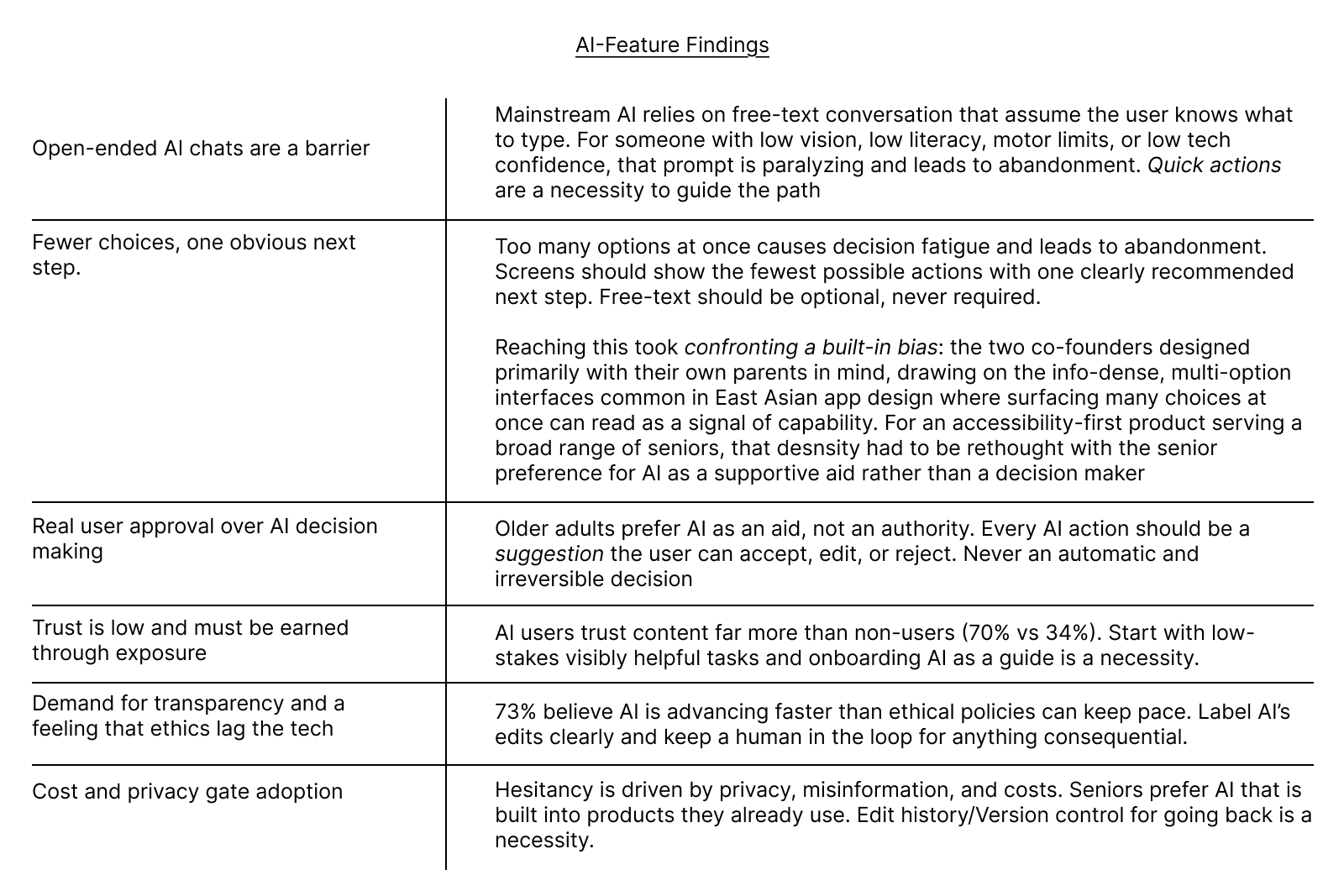
The recording experience is built for voice. Large, high-contrast controls make recording, pausing, and saving feel immediate — no prior experience needed. Record in fragments across multiple sessions, reorder clips freely, and attach photos from your camera roll to anchor memories visually. Every version saves automatically. Nothing is ever lost.
Once transcribed, the Draft Copilot steps in as a collaborative editor. It reads the narrative, identifies gaps, and asks the questions that surface the details a speaker may have skimmed over. Adjust tone, pacing, structure — and build connections through conversation. Type a response, send a voice memo, or tap a suggested reply. The story stays yours.
Tell It Together — Community and sharing
Invite family and friends to contribute their own perspective and map the relationships between the people and moments that shaped your life. When you're ready to share beyond your circle, flexible privacy settings let you open stories to a global or local community — or keep them entirely private. Read about the experiences of others, discover unexpected connections, and contribute to a tapestry of lived memory that extends well beyond your own.
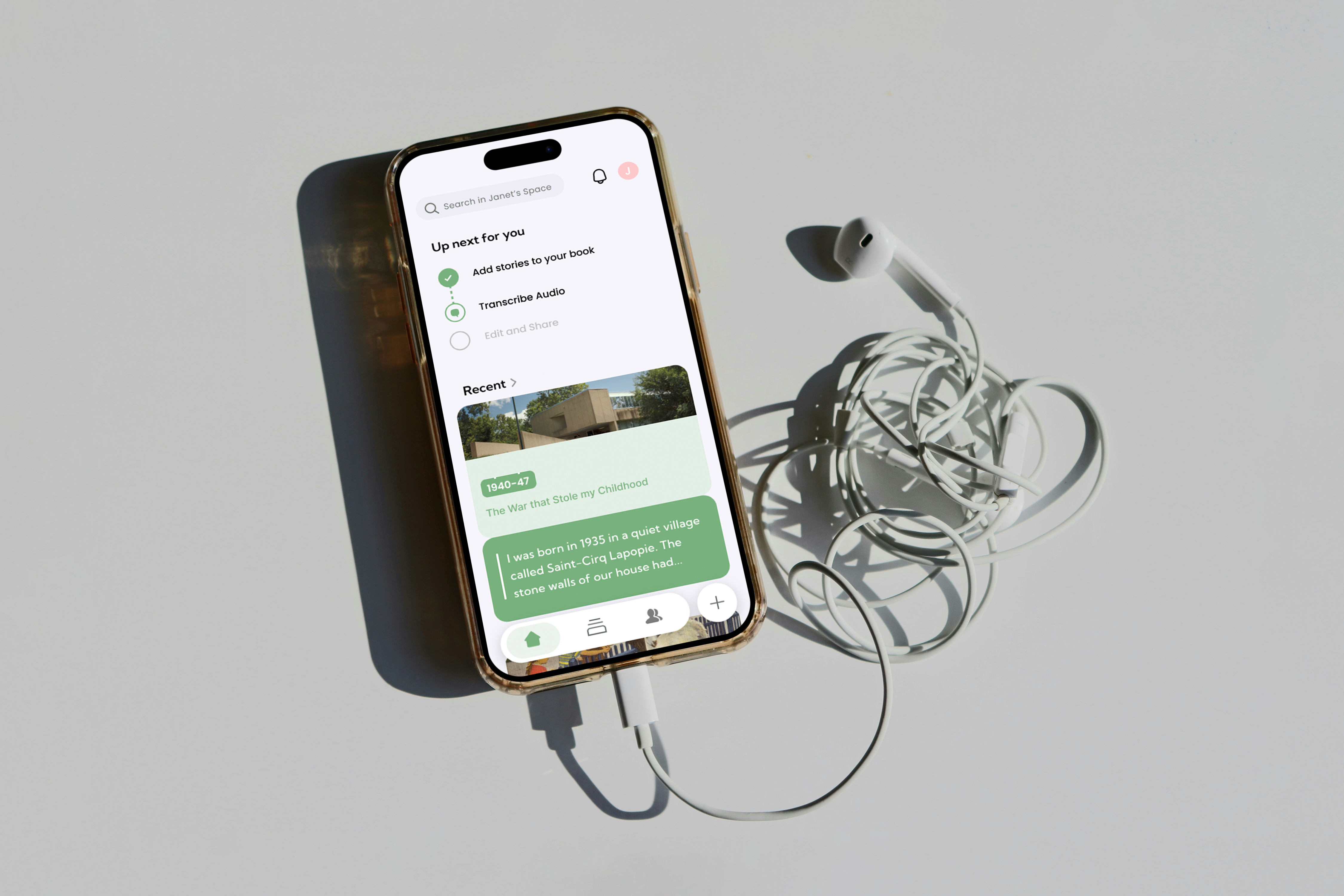
05 — Home Screen
Three decisions that shaped the home screen.
The home screen is the first interaction and every element had to earn its place. It needed to guide first-time users to start, return users to continue, and active community members to their conversations — without the same answer for each. Three decisions shaped the final design.
The banner responds to where you are in your journey. No stories yet and it invites you to record your first memory. Mid-story and it nudges you to keep going. Stories ready and it surfaces the book. Active in community and it pushes comments waiting for you. It moves with the user instead of staying static.
Recent stories surface with their opening sentences rather than just tiles. Seeing the first line of a story you wrote pulls you back in without any friction. It triggers recall the moment the app opens — a choice informed directly by our user testing with seniors, where visual tiles alone failed to prompt re-engagement.
The timeline date reflects when the memory actually happened, not when it was recorded. This distinction grounds every story in a real life rather than an app activity log, and gives the home screen the feeling of a personal archive rather than a feed.
06 — Final
Lives to Tell, resolved.
By embedding accessibility early, we created a design framework that reduced rework and expanded the addressable market — senior homes, diaspora communities, families across language barriers. My grandmother was editing stories by voice within a week, with no prior smartphone or AI experience. That's the result I kept coming back to.
"Our mission is to help people preserve and share their life stories, legacies, and memories with family, friends, and communities. By making storytelling simple and accessible, we aim to strengthen family bonds, foster intergenerational connection, and support the mental, emotional, and social well-being of adults."
LivesToTell — Mission Statement